
Susan Greenfield is a very scary neuroscientist! In her book Mind Change: how digital technologies are leaving their mark on our brains, [2012] she describes the global, controversial, multifaceted phenomenon of digital technology and what happens to the brain when working almost entirely in a two-dimensional world.
Oh, there is so much in this book that has hit me hard! Too much to summaraise. But here are a few snippets:

Social networking: junk food for the brain. Your identity is no longer internalized and worked out through deep thought as it is in a 3D setting. The increasing need for attention can mean increased loneliness.
Video games. There is high correlation between the games and increased aggression, obesity, and recklessness. In addition, the fiction of games starts to inform the brain that they are real – the brain cannot differentiate between fiction and non fiction.

The future is happening now. What to be aware of:
- Eye contact, learning to empathise, and interpreting body language cannot be learned in two dimensions. Face-to-face interaction will become uncomfortable.
- shorter attention span, no deep thinking.
- Personal identity is increasingly defined by approval of a virtual audience.
- No strong sense of who you are –no past or future, just the atomized moment. Constantly trapped in the present.
- Continuous state of high arousal with no time to think about one’s own identity.
- Craving novelty and stimulation as each input is evaluated on purely sensational terms and soon palls.
- Vulnerable to manipulation, in how you see the world and how you react.
- Adapted to constant approval of others, so will readily conform.
- Blurring of reality, of fact and fiction.
- Digital equipment means being terrified if left without it. [example of phone users “panicked”, “desperate”, “sick” if they are without their phone. Way back in 2012!]
- A trend of under-stimulation of touch, taste, smell, sex drive – leading to obesity.
- Hard to keep one’ own personal narrative. Loss of privacy.
And Yet….
And yet…. knowing and watching these trends increase in countless scenarios around me, heart-enriching events were happening as well. This summer, the families of both daughters were here together. Yes, they were all fully knowledgeable and competent in the two-dimensional world. But that wasn’t where the magic was taking place.
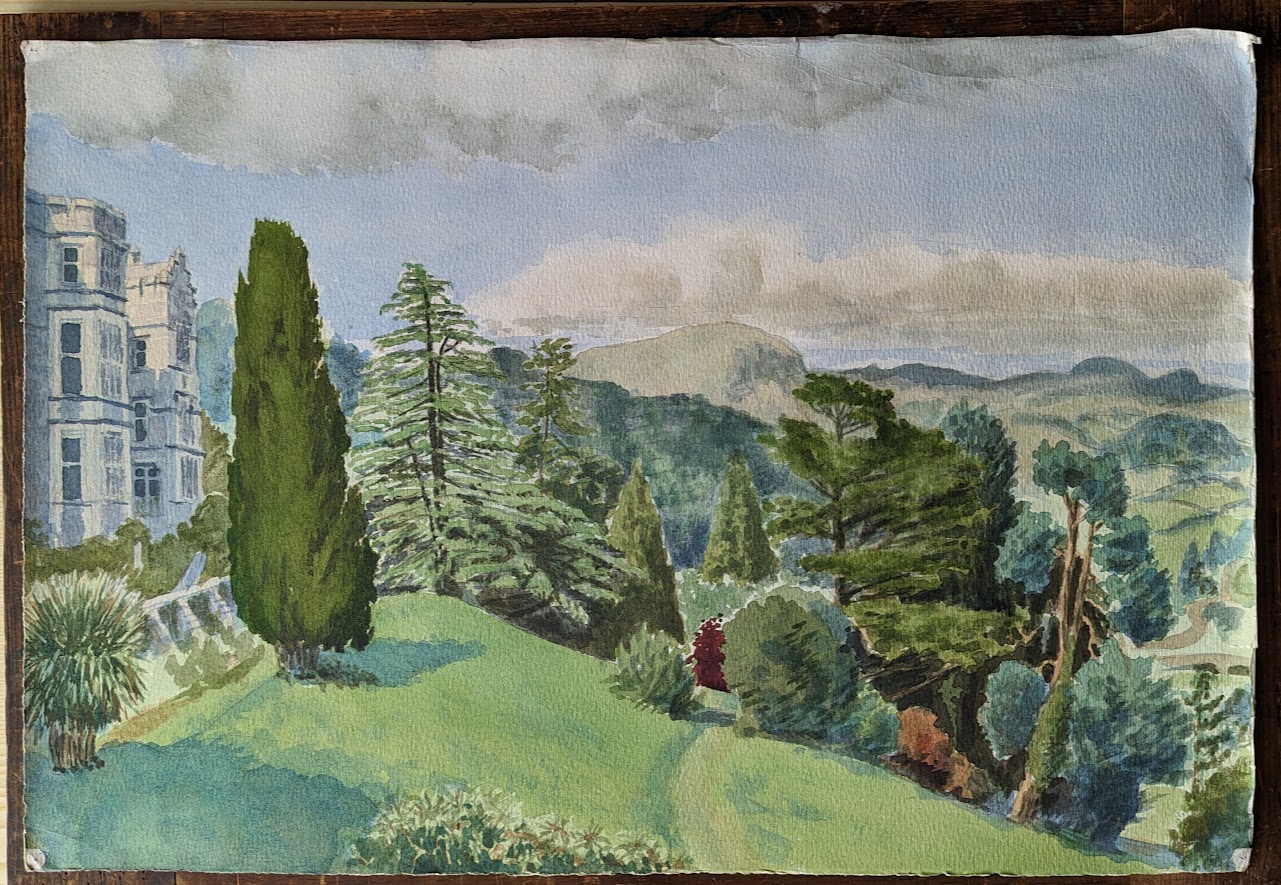
(Unfinished watercolours by John F. Robinson. Photographed by Pietro Calogero, with deep thanks — part of his holiday.)

Both families all squished together around one table for meals, just being themselves (no smartphones in sight). The laughter, the delight in being together!
.


Unashamedly singing solos to each other in the kitchen, tea towel in hand.
Sisters playing music just for the fun of it with exuberant cheers when managing to make it to the end of the piece….at the same time!
A brief wisp of a tune trickling out of fingers passing by the piano.



Applause at the successful completion of a complex jigsaw puzzle.
Stories of the past we all knew well, but repeated anyway.
The shared memories of a beloved husband/father/grandfather;



Feeling free to take time alone in quiet art work, underneath the natural conversations going on above them.
Using terms the children said when young, which don’t mean anything to an outsider but are now cemented into family identity.



Quiet opportunities for one-to-one sharing.
The walks together, sometimes in the rain, through beautiful countryside.
Brain-enhancing learning through handling, seeing, sitting in ancient history, tasting, attempting, smelling, hearing.

Celebration of marriage renewal vows — in a tree!
The saddened hugs of farewell.
Pearls of Great Price. Loved human being to loved human being. All three-dimensional. All sacred. Hang onto them.
Kathi Rolls

Last Christmas I received the gift of a pizza-sized box full of little cardboard doors that opened onto spices of street foods around the world. It has been a joyous experience to try them out. Here is one from Northern India. I grew up in N. India, and don’t remember having these at all, but perhaps my classmates from that time will put me straight.
I’ve used this recipe with many fillings, including Vegetarian, but here is the one straight from its little cardboard cupboard.
Kathi roll blend: 1 tsp each of ground coriander, ground cumin, and garam masala, and ½ tsp chilli powder.
500g (about 1lb) diced chicken (thighs are best)
1 red onion, thinly sliced
1 clove of garlic, finely chopped
Fresh ginger finely chopped to make 2 tsp. [or ginger puree from a jar/tube]
1 sweet pepper (any colour), thinly sliced
½ lemon
10g bunch of coriander (cilantro) roughly chopped
100g (1/2 cup) natural yogurt – Greek style is best
4 eggs, beaten and seasoned with a pinch of salt.
4 large wraps or tortillas
Mango chutney and salad to serve.
Mix the chicken with the yogurt, garlic, ginger, juice of 1/2 a lemon, and the Kathi Roll blend. Add 1/2 tsp salt. Leave to marinade.
Fry the onion and pepper in 3 tbsp oil for 10 minutes until soft.
Add the chicken, including the marinade, and fry for 10 minutes or until cooked through and beginning to brown on the edges.

Heat a very large frying pan (the size of the tortilla) with 1 tbsp oil until very hot, then pour in ¼ of the beaten egg to make an omelette. Cook for 30 seconds or until the the egg has started to cook around the edges.
Place one of the wraps on top,press down, then continue to cook for 1 minute or until the omelette has set to the wrap.
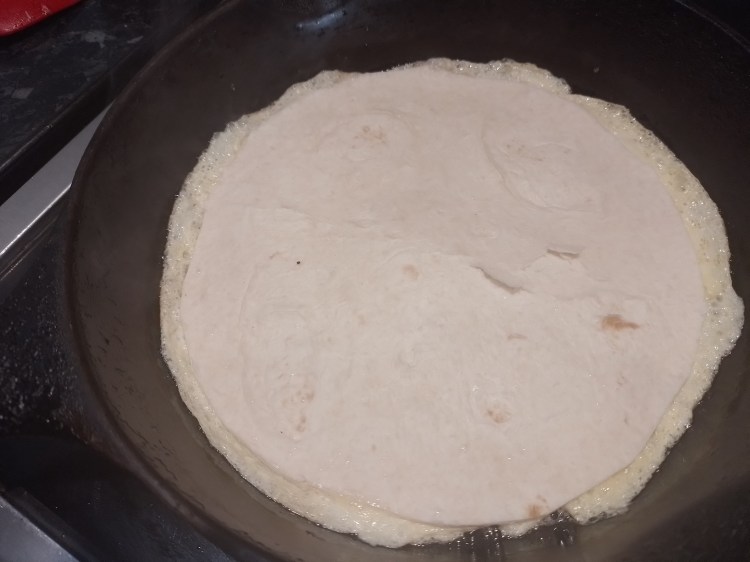

Using a spatula, flip wrap over and cook a further minute or until wrap is golden brown and egg is cooked through.
Place on a large plate egg side up. Cover with clean cloth or foil to keep warm, then repeat with remaining wraps.
To serve, stir the coriander (cilantro) into the chicken-onion mixture then divide between each of the egg wraps with 2 tsps mango chutney and roll up like a large fajita, with the salad on the side.

Verdict: This could do with a lot more chilli spice. I added a de-seeded chopped chilli to the filling.
Warning: Do not not not attempt to photograph the omelette-tortilla stage of preparation. You can see from my photos that burning is inevitable!


I’m hungry, and I don’t even care for Indian food!
Shabash, anyway, dear sister-in-law!
LikeLike
Hope that you found something you DID want to eat!
Love,
Judy
LikeLike
……a home-madde pasta salad….
LikeLike
Great! J
LikeLike
Very interesting, Judy. We should take this as a warning!
LikeLike
Two stories in one – it was lovely o meet your families around the yew tree.
LikeLike
So glad you wandered by at that moment!
Judy
LikeLike
Judy, Johns’ ‘unfinished’ watercolours are fantastic and great to have them recorded and shared.
I bought Susan Greenfield’s book some years ago as it also ‘chimed’ with my own feelings on the way the world was going and sure enough it confirmed the potential damage it would/could create. I am not sure we were created to interact impersonally – text not talk, work from home alone, video conference not meet, rely on technology with no backup solutions etc. Our offspring will doubtless make the best of it but as Susan explains it will leave its mark on our brains!
LikeLike
Thanks. I’m glad to have photos of the paintings. And I already see some offspring (young working adults) getting together to play video games, stopping, and then pulling out the board games (Greenfield says these stimulate the brain positively.) Soooo, Ian, perhaps our offspring are already looking for balance.
Judy
LikeLike
This menu looks delicious! I think I know what we’re having for lunch….
And yes, it was a beautiful, graced, full time together.
LikeLike
Thanks for the picture of the food! My hopes are to put it on the blog for others to see.
J
LikeLike
I don’t think much of that book’s statements, nor do the Baronness’ scientific colleagues. In that book, she claims she “decided to present a perspective through the prism of neuroscience” (emphasis added). In her media columns prior to the book’s release, she was consistently criticized by her neuroscientific and medical colleagues, asking her to put forward her findings in a peer-reviewed forum rather than the Daily Mail.
This book was the answer to that, but she also claims in that book that her “paradigm”, by definition, cannot be tested: “[i]t is impossible to demonstrate definitively that screen-based activities have no effect at all on the brain or behaviour, any more than I or anyone could prove definitively, to use an age-old example, that there is NOT a teapot in orbit around Mars.” I find that people who insist that their statements be taken as true, because definitionally they cannot be taken as false, to be remarkably unconvincing.
Every generation sees the younger one and says, “They are not [positive communication/human interaction value] in the way I am accustomed to recognizing; therefore, such [positive communication/interaction value] is not happening at all.” Which, it need not be said, is a falsehood. I wish I could find the first place I saw this described; it had a delightful series of quotes from the ages about newspapers on subways (photo by Stanley Kubrick!) and the printing press and such. The Baronness’ book goes further and attempts to wrap this criticism as biological and neuroscientific fact – that, by her definition, would remain unchallenged because they’re a ‘paradigm’ that ‘cannot be proven’ false – even though comparing the likelihood of her theory being true to the likelihood of a teapot in Mars orbit is kind of a self-own …
I wouldn’t call myself faceblind, attention-deficient, always performing, timeblind, reactive, overstimulated, susceptible, sycophantic, delusional, digital-addiction, sense-deprived, and disassociated. (I would consider myself touch-deprived and attention-deficient. The former is trauma-related, the latter is actually a function of my particular intelligence and memory levels, according to a multi-hour neuropsychological exam. I don’t attribute either to digital devices, nor did that physician.) I don’t see those as defining me, and I’ve been a computer nut (since 1986) and a game system since the Atari (some point shortly thereafter). I also don’t see those descriptions as defining the whole of your grandchildren’s generation, nor any generation before or after.
Since its beginning, humankind always sees the apocalypse right around the corner. Since Socrates (likely before), disrespectful youth are causing societal decay. Humankind tends to find it easier to criticize than to empathize, easier to foster fright of the new rather than explore its newness.
TikTok, that great bastion of evil, has people telling people who happen to be across the globe to take care of each other, and helping them breathe, and doing many many other good things. YouTube has neuropsychologists helping people through their trauma. There are young ones organizing school protests to make sure that trans people are not legislated out of existence – and they’re doing so online [9]. As for videogames, Tetris, for example, works (accidentally but provably) to help delay the absorption of trauma. And the ‘evilness’ of certain games has been going on since Jack Chick illustrated religious comics about supposedly real sacrifices being made in the basements of colleges for “real-life Dungeons & Dragons”.
LikeLike
Maybe it’s as easy to disprove as it is to prove. But I’m seeing it almost everyday in this small rural village. Thank you for your thoughts. Getting an overall perspective is important. Meanwhile we all trust our own experiences.
Judy
LikeLike
Judy, I always enjoy reading the articles that accompany the recipes in your blog. You outdid yourself this time. Thje predictions from 2012 by this lady are spot on. Very sad. On the up side, I’m so glad you had quality time with Lizzie and Joy and their families. Great memories for thew future…
LikeLike
Thanks Jim — as I was writing this, and even after I published this, I wondered whether it was the right thing to do, so your positive comments make me say, “whew”!
Thanks, too, for subscribing — I wrote you an email but sent it to the wrong place!
Judy
LikeLike