
The King’s Award
The building was packed with dignitaries. Everyone representing something or someplace important, including a messenger from the King was there. For once, the ceremony was not in their honour. They were here in solemn respect for those being celebrated.
The hall was festooned in huge bouquets of flowers. There was live music, choirs, speeches of appreciation, and the atmosphere was bubbling with pride from attending celebrants.

For today, 13th March, 2025, we were here to honour the King’s Award for Voluntary Service. Seventy-two people, representing 6500 hours of volunteering in 2024, were to receive the MBE (Member of the British Empire) for volunteer groups, the highest honour a volunteer could achieve. The Hub aka St Peters Church, is the central point not only for church services, but for café food and drinks, youth club, library, social proscribing, free parties, singing, and far far more. Two members will go to Buckingham Palace later this year, on behalf of them all.
The King’s Citation begins with his astonishing title:
“Charles the Third by the Grace of God of the United Kingdom of Great Britain and Northern Ireland and of Our realms and Territories King, Defender of the Faith, to The Hub and St Peters.”
And the Official Quote from Paul Deneen, OBE, JP, DL, “The Hub has been truly transformational, delivering an extraordinary range of volunteer-driven services. It addresses all the endemic problems facing the local community, and is an outstanding example of how volunteering can improve quality of life and community cohesion”.
His Majesty’s Lord Lieutenant Edward Harley, CBE presented the citation and and the crystal award
Afterwards, the important time , well-nourished with tea and overflowing refreshments, the dignitaries became normal people as they chatted with humble respect to those who make this hub a growing, developing centre of welcome to all who come in for any reason. The volunteers’ responses were positive and enthusiastic: “we want to help, to be here,” “we enjoy it!”, “yes, it’s tiring sometimes, but we would rather be here than anywhere else”, “it’s not something we have to do. It’s something we choose to do.”
It was a great occasion — wonderful and solemn.
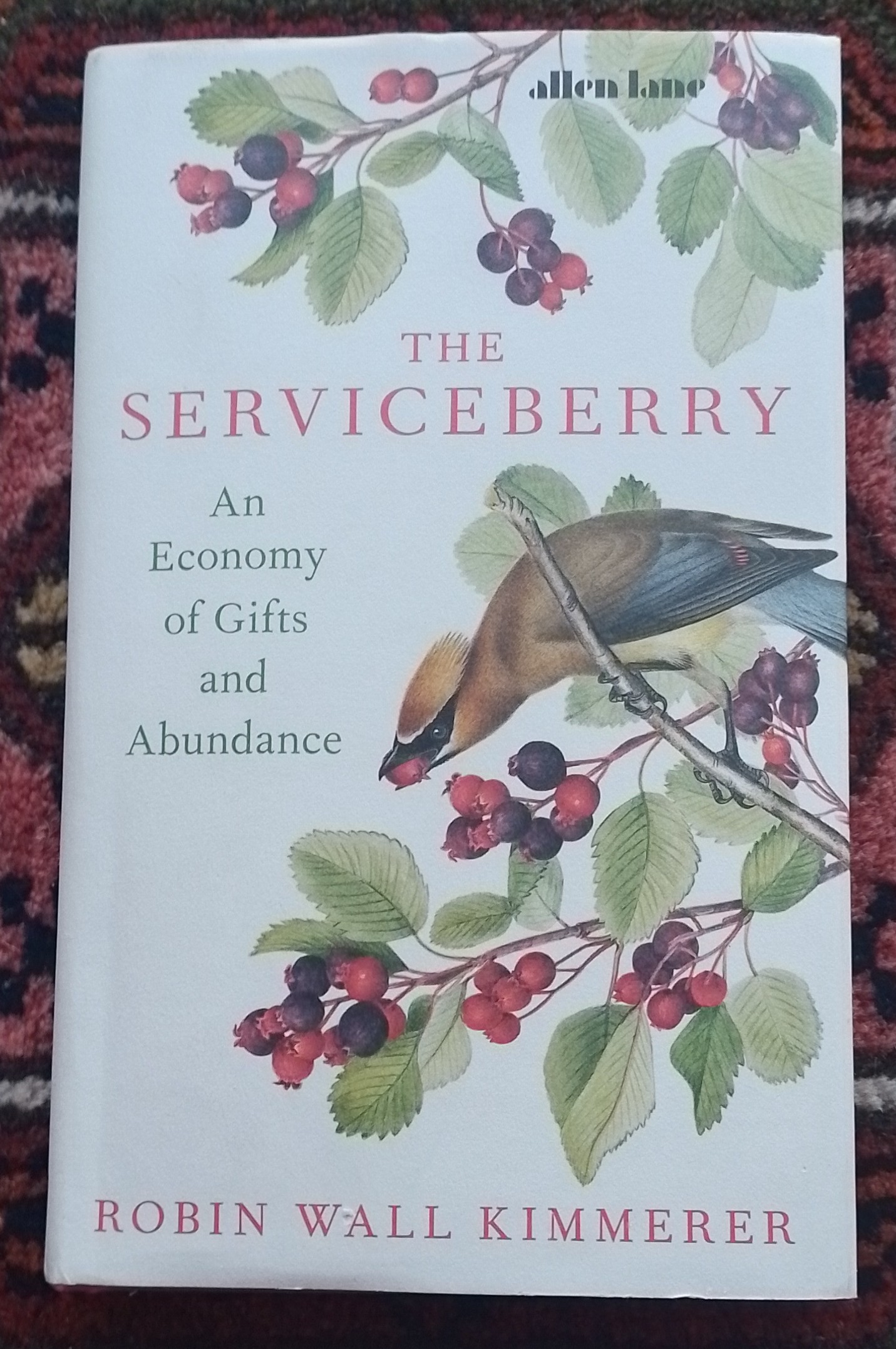
An Economy of Abundance or Scarcity?
And it reminds me of The Serviceberry, a book written by Robin Wall Kimmerer, talking about the economy of abundance: the trees’ abundant berries are gathered, made into pies for other people who then donate their time to someone else, who…..you get the picture. Our economy, she says, is built on the economy of scarcity, competition, hoarding of resources, actively harming those we love. But what about living the economy of abundance? The serviceberry’s relationship with the natural world embodies reciprocity, interconnectedness and gratitude. The volunteers at the Centre, too, find joy and friendship in giving their efforts and skills to others.

Of course, there is already an economy of abundance in our community. It’s hidden, not talked about. This King’s Award is an exception. And there are lots more than the seventy-two MBEs. There are people in our community who care about doing their job right, who work extra unpaid hours. Fundraisers for a good cause, here or abroad. People who make Christmas special for village children. Those who create flower festivals or community quizzes, who bake, raise plants to swap, offer wheelbarrows of free apples for the public. Those who look out for frail neighbours. Campaigners for clean rivers and carbon-neutral environments. Free Book stands. Community meals. Home communions. Supporting asylum seekers and newcomers. Caring for invalid relatives. Checking out on those living alone. Book groups, singing groups, pudding clubs, language groups, model railways. Drawing the community together online as well as magazine editors. Knitting for a beloved. How many more thousands of volunteer hours are already present, building us into an organic, healthy, welcoming whole? Countless!
This probably happens in your community, too. Perhaps you are part of it. If you are, congratulations and best wishes! Recognise it. Rejoice in it. Praise others who contribute. They may not win prizes from a King, but anyone who helps to turn us into an ecologically balanced economy, where money matters less than community, is worthy of praise and humble gratitude. It’s the Economy of Abundance, a Gift Economy, an Economy of Trust, and it’s a joy to take part.
Slow Cooked Venison in Juniper, Orange, and Whisky Sauce.
The Food Alliance here is encouraging us to use local products. I am privileged — this area produces local vegetables and meat.

Recipe taken from Slow Cooking by Katie Bishop, who says “This dish is everything a venison casserole should be – warming, hearty and refined.” But that’s up to you to decide, isn’t it? (I’ve put my substitutions in italics.)
1 Tbs olive oil
400 g (14 ozs) diced venison steak
8 shallots peeled (2 onions)
250 g (9 ozs) button mushrooms wiped, filles 2 ½ cups
25 g (1 oz) butter. About a hearty tablespoon
1 heaped teaspoon juniper berries, lightly crushed
100ml (3 ½ oz) whisky – about ¼ cup.
2 tbsp plain flour.
300ml (10 oz,) beef stock about 1 ½ cups
1 fresh rosemary sprig
Juice of 1 orange (tangerine)
Sea salt and freshly ground black pepper.
(I also added chopped wild garlic.)
Warm the oil in a large frying pan over medium heat, add the venison and cook for 5 minutes, or until brown. Spoon the meat into the slow cooker dish. If cooking in the oven, place in a casserole that has a tightly covering lid.
Return the frying pan to the heat, add the shallots (onions) and mushrooms and cook for 5 – 10 minutes or until brown. Add the butter, juniper berries, and whisky and allow to bubble up for 1 minute.
Mix the flour in half the stock until smooth. Spoon into the slow cooker dish (casserole dish). Add the remaining stock, the rosemary, and the orange juice. (plus orange peelings).
Cover with a lid and cook on low for 8 – 9 hours or until the meat is “wonderfully tender”.
OR place the casserole dish in a low oven 150 C, or 300 F, Gas mark 2 and cook for 4 hours, or until the meat is “wonderfully tender”.


 foodthatbuildscommunity.com